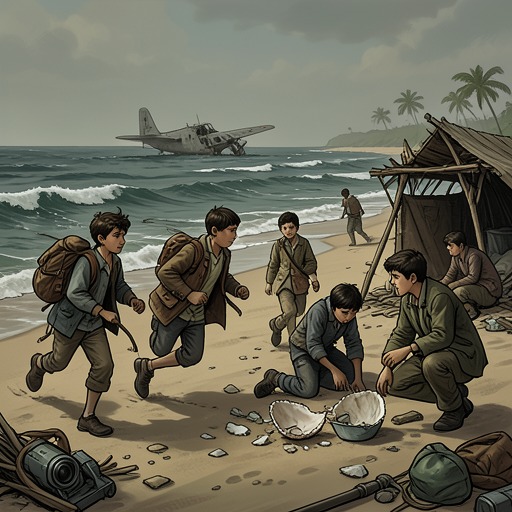
The first assembly and Ralph’s election as chief
Lord of the FliesThe first assembly and Ralph’s election as chief mark the moment when the scattered boys begin to form a society—and when they entrust its leadership to Ralph rather than Jack Merridew. A shell raised from the lagoon first summons them; around it, the boys name themselves, acknowledge that no adults are present, and choose a chief. The choice gives their new order a public beginning, but its authority rests on symbols, consent, and procedures that the boys will later contest and destroy.
The call and the gathering
Ralph finds the shell in the lagoon while Piggy urges him to think about finding the other boys and deciding what to do. At first, Ralph treats it as an attractive object and tries unsuccessfully to blow it. Piggy explains how to make a sound by blowing from the diaphragm; Ralph’s next attempt produces a deep, harsh note that carries under the palms, through the forest, and back from the mountain. Birds rise from the treetops, and something moves in the undergrowth. The sound makes the shell useful not just as a find, but as a means of calling people together.
Ralph keeps blowing, and boys emerge from the palms and forest, arriving singly or in pairs at The platform. Among those who come are the twins Sam and Eric, whose identical appearance and shared movements briefly confuse the gathering as Piggy tries to distinguish them. The assembly is not called by an established authority: the signal itself creates the crowd, and the boys’ attention settles on the person holding it. When Ralph finally stops, the fading echoes give way to silence, turning a noisy collection of arrivals into an audience.
Names, status, and the election
The gathering begins to make its members recognizable. Piggy supplies names he has just learned, including Johnny and the twins, while Ralph says his own name. Jack Merridew rejects being called by his first name and insists on the authority of his surname. When Piggy tries to contribute, Jack silences him and calls him Fatty. Ralph answers by revealing the name Piggy had privately asked him not to use. The laughter leaves Piggy isolated, even as the boys’ public naming gives the group a first, uneven form of shared identity.
The group also takes shape through the differences among its members. Jack Merridew arrives in charge of a uniformed choir party, whose members wear black cloaks and square caps; among the other boys is Roger, who keeps to himself and speaks little. Simon, introduced as a choirboy who has fainted, is present when the boys turn from identifying themselves to deciding who should lead. Their different standing matters: Jack has an organized group and claims a leadership basis in his role as head boy and chorister, while Piggy contributes much of the practical intelligence but has already been made a target of ridicule.
Jack Merridew says he ought to be chief, citing his position as chapter chorister and head boy. Roger proposes a vote. The suggestion catches on: the boys like the novelty of voting, and the demand for an election grows into acclaim for Ralph. The choice is not presented as a reasoned assessment of qualifications. Jack appears the more obvious candidate, and Piggy has supplied much of the useful thinking; Ralph is selected instead because of his size and appearance, his composed presence, and, most powerfully, his association with the shell. The boys identify him as the one with the shell and call for him to lead.
The vote makes that preference concrete. The choir raises its hands for Jack Merridew. When Ralph asks who wants him, every boy outside the choir except Piggy raises a hand immediately; Piggy then joins them reluctantly. Ralph counts the votes and declares himself chief. The election gives his leadership the appearance of collective authorization, while Jack’s visible defeat leaves a rival claim to authority in the same assembly. Jack blushes with mortification, starts to rise, and then sits back down.
A first division of authority
Ralph tries to soften the defeat by offering Jack Merridew command of the choir. Jack chooses to make them hunters. The arrangement both preserves Jack’s standing and assigns a practical purpose to his organized group. Jack has already tried to cross the hill to see whether water surrounds them, but the sound of the shell brought him back; now his choir is recast as a force that can hunt for food. The appointment therefore turns a formal election into a division of responsibilities, without resolving the difference between Ralph’s elected leadership and Jack’s personal authority over his followers.
Ralph’s next decisions give the assembly a working agenda. He says the boys must determine whether they are on an island and proposes that only three boys go on an expedition, to avoid the larger group becoming mixed up and losing one another. He chooses Jack Merridew and Simon to accompany him. Jack’s knife, struck into a tree trunk as he steps forward, makes the expedition’s practical purpose—and the force he brings to the group—visible beside Ralph’s appeal to collective choice.
At a later assembly, Ralph makes the shell into an explicit speaking procedure: the next speaker is to hold it and is not to be interrupted, except by Ralph. Jack enthusiastically calls for rules, and Piggy uses the shell to regain the floor when the boys’ shouting threatens to drown out discussion. The procedure gives the boys a recognizable way to convene and speak, but its authority depends on their willingness to observe it. On The mountain, Jack later accepts rules and agrees that his hunters should help maintain the signal fire; during the later argument over the beast, he rejects the rules and leads the boys away. The contrast reveals the distance between agreeing to a system and submitting to it when it limits power.
The election’s fragile legacy
Ralph’s election matters beyond the initial choice because it sets up the terms of the boys’ political conflict. Ralph’s authority begins in a vote and in his association with the shell; Jack Merridew’s rests on his choir, his command of the hunters, and the promise of hunting. The first arrangement allows both forms of power to coexist, but the later assemblies expose their tension. When Jack declares that the rules do not matter and urges the boys to hunt, Ralph argues that the rules are all they have. The scene reverses the hopeful beginning: the chief chosen by acclaim cannot make that acclaim enforce obedience.
The shell’s changing fortunes make the reversal especially stark. In the first gathering, its sound summons the boys and its presence helps distinguish Ralph as chief. Later, Jack insists that it does not count at his end of The island, while Ralph maintains that it counts everywhere. At Castle Rock, Piggy holds it up as he appeals to the boys to choose rules and rescue over hunting and destruction. Roger releases a great rock; it strikes Piggy and the shell explodes into fragments. The destruction of both Piggy and the shell ends the visible basis for the assembly’s authority, while Jack announces that he is chief and attacks Ralph.
The first assembly thus establishes an order that is real but not secure. It turns a call into a crowd, a crowd into an election, and an election into an initial division of duties. Yet the event also plants the conflict that will undo that arrangement: leadership by collective choice exists alongside command by personal allegiance, and rules can organize the boys only while enough of them accept their limits. At the end of the hunt for Ralph, an officer on the beach says that the smoke brought the rescuers to The island. The boys’ final rescue gives the signal’s purpose a grim echo: the shared order founded around the first call has collapsed, but smoke still makes the island visible from outside.